[H]ad The National not spent money the way that it did [...] Peter Richmond wouldn’t have had the chance to go to a Cubs game with Bill Murray and then hang out with Fleetwood Mac afterward. Which would have meant that we wouldn’t have had the great scene several months later when Murray showed up in the New York offices to see Peter. Not long before that, a guy not many people liked had been fired, and Murray wandered into the daily editorial meeting, propped his flip-flops up on the table, and asked, “Show of hands. How many people thought [blank] was an asshole?” The world would be a poorer place without that moment.
Category: Arts
Jun10
May23
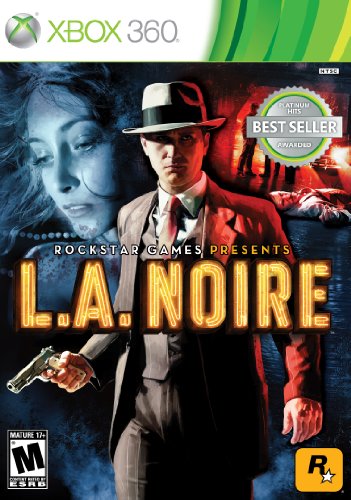
L.A. Noire
If you’re wondering how to reconcile the high mark to the left with the paragraphs of red ink below, let me explain. L.A. Noire is a very good game that wears all its faults on the outside.
It boasts several major achievements. The first is MotionScan, the facial animation technology that represents the boldest effort yet to bridge video games’ Uncanny Valley of facial expressions. The game’s interrogations are meant to put the technology front and center, asking the player to read these facial cues to sift truth from lies.
The second is its detailed portrayal of post-war Los Angeles. I’m no expert, but they don’t seem to have taken many shortcuts here. They’ve modeled nearly one hundred real-life vehicles, all of which are driveable within the game. They claim to have recreated 90% of downtown L.A. with painstaking fidelity to architecture. The wardrobes, the music, the signage… hardly anything feels anachronistic.
These things are well worth bragging about. But they have nothing to do with the gameplay. L.A. Noire mixes slow, static scenes, like interrogations and crime scene examinations, with open-world, sandbox-style tasks on a city map. These are tough to blend. It’s disorienting for a game to feel like Heavy Rain one minute and Grand Theft Auto IV the next.
Something else bothers me more, though. At moments few and far between, L.A. Noire is simply no fun to play, and the fact that it was fun to look at was the only thing that pushed me out of the ditch. Yes, it’s nice to be able to “read” characters, but not within the context of a dialogue tree that combines the worst aspects of Encyclopedia Brown logic and Phoenix Wright logic.
No, seriously. This is why solve-the-mystery gameplay is so hard to do well. At its best, it lets the player feel smart as he pieces together clues and has sporadic eureka moments. But far more often it feels mean, as though the player is being punished because she didn’t follow the game’s own Moon Logic. There are several places in interrogations where you’re supposed to accuse someone of lying after they’ve said something true — and, when asked for proof, present a piece of evidence that doesn’t contradict what they said.
At least Phoenix Wright allows for a bit of trial and error as a way of navigating its odd flavor of Moon Logic. In L.A. Noire, a missed question might be the difference between five stars and three on your case rating. Now, on one hand, the case ratings are ancillary and I shouldn’t take them so seriously. On the other hand, the game moves forward at the same pace whether you’re good at it or not, so the case ratings are nearly the only reward that the game offers for skillful play. I want this game to be more than a twelve-hour-long movie, but it fights me all the way.
The facial animation, while revolutionary, isn’t yet perfect. About 70% of the time, characters’ faces look like those of human beings; about 15% of the time, they look like flat images projected onto egg-shaped surfaces; and the remaining 15% of the time, they look like Vincent D’Onofrio in Men in Black. And the way they’re captured — under bright lights, in front of 32 cameras, sitting in a barber’s chair — might be to blame for some ham-filled performances by minor characters. At times I was reminded of interactive movie games, the scourge of the mid-90s adventure genre, and their tendency to feature the worst line-readings this side of a pornographic movie.
The story is solid. Often, I didn’t like the way plot developments unfolded, but I dare not complain about such things, lest we be thrust back into the age where you had to learn a game’s story by reading its instruction manual.
You should play this game. I don’t know if you should buy it, but you should certainly GameFly it or borrow it from a friend or sell it back to GameStop four days after you purchased it. You should play it not just because it’s a good game, but because I suspect it’ll be an important and influential game — in the same way that it’s important to see Star Wars just so you can know what people mean when they reference it.
Some reviews seem to give near-perfect ratings to L.A. Noire because of its technological achievements — even as they admit its flaws. I can’t do that. I can’t even spot it a few points for causing me to rewatch L.A. Confidential. Instead, it gets the most heart-wrenching B-plus I’ve ever given.
Apr26
The best way to think about the old NFL collective bargaining agreement is as a beautiful magic cloak. It allowed the owners a kind of charmed invisibility when it came to collusion, to artificially controlling competition, to inhibiting player movement, to making their costs certain, and generally suppressing every free market principle. The fact that they had the consent of players via collective bargaining created a non-statutory labor exemption — it gave the owners legal cover for the socialistic anti-competitive way they operate. [...] The owners, almost incomprehensibly, voluntarily stripped off their magic cloak and ripped it to shreds, when they opted out of the CBA and demanded $1 billion in concessions from players. They tore up their cloak because, they said, their share of $9.4 billion in revenue wasn’t enough to support them in the style to which they’ve become accustomed.
Jan4
I don’t know what I see when I watch football. It must be something insane, because I should not enjoy it as much as I do. I must be seeing something so personal and so universal that understanding this question would tell me everything I need to know about who I am, and maybe I don’t want that to happen. But perhaps it’s simply this: Football allows the intellectual part of my brain to evolve, but it allows the emotional part to remain unchanged. It has a liberal cerebellum and a reactionary heart. And this is all I want from everything, all the time, always.
Dec13
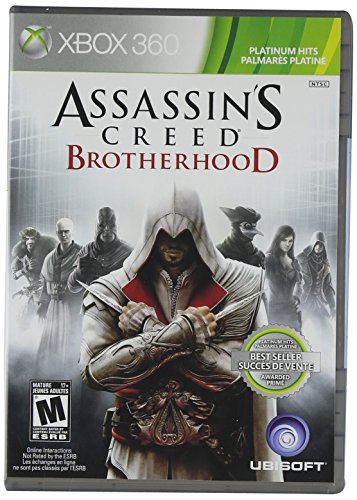
Assassin's Creed: Brotherhood
To express my feelings for Assassin’s Creed: Brotherhood, I had to track down a sentence Roger Ebert wrote: “Learning the difference between good movies and skillful ones is an early step in becoming a moviegoer.” In the last few years, I’ve started to notice the “skillful video game” trend: a game that’s got all the polish in the world but isn’t any fun to play.
In fact, here’s my review of the entire Assassin’s Creed series: each game gets worse even as it gets more skillful. It was plain to see, for instance, that the series of carefully-planned, oh-shit-here’s-my-chance assassinations in Assassin’s Creed had been rejiggered for the sequel; it became a series of extemporaneous situations that seemed to reward lack of planning. (“Who is this guy? Why I am I killing him? Screw it; I’ll just run up and fire my pistol.”) But it also fixed so much of what was wrong with that first game and gave me a gorgeous depiction of Renaissance Italy to freerun around. I was satisfied.
But something’s gone wrong. Brotherhood has added so many layers of sound that it’s lost the melody completely. Is Ezio singularly focused on getting back the Apple of Eden, the MacGuffin crucial artifact that can exert absolute control over mankind? No, he’s balls-deep in Roman real estate, buying shops so he can earn more money so he can buy more shops. Or he’s training new recruits with a menu-driven process that’s about as exciting as Progress Quest.
None of this has anything to do with the plot of the game, but that’s the whole point. Filler of the Brotherhood sort is quite common in modern games. It’s an easy way to parallelize the development process: the team that works on the side quests doesn’t have to keep in sync with the team working on the main quest. But it’s also an easy way to bury the kernel of an excellent game beneath a stack of laundry lists.
A stronger story might have saved this game. Any story might have saved this game. As it is, there’s only enough plot in place to set up a stupid cliffhanger ending. But it’s getting hard to care about what happens in the present-day universe of the game when I know I’ll be spending most of the next game in a machine, helping my ancestors become real estate moguls.
Aug25
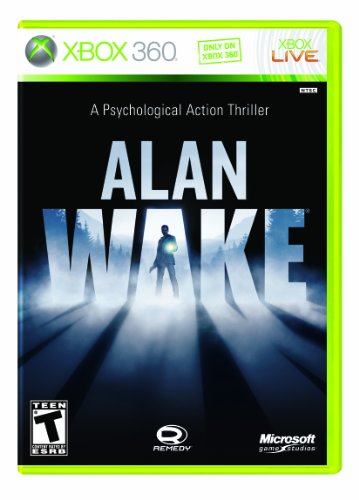
Alan Wake
“Stephen King once wrote that nightmares exist outside of logic, and there’s little fun to be had in explanations. They’re antithetical to the poetry of fear. In a horror story, the victim keeps asking, ‘Why?’ But there can be no explanation, and there shouldn’t be one. The unanswered mystery is what stays with us the longest, and it’s what we’ll remember in the end.”
That’s the voiceover that begins Alan Wake, a game that borrows more than a little from King’s oeuvre. The game was written by Sam Lake, who also wrote the stories for the Max Payne series, but I fear he’s taken the wrong message from King’s words, and purposefully set out to write a story that makes no sense. That’s not quite the same thing.
I have few words for Alan Wake’s gameplay, which is neither awful nor fantastic. I echo the praise for the game’s atmosphere and its associated light/dark gameplay mechanic. But I could write a whole book (under the guidance of my own particular Dark Presence, no doubt) about this game’s incoherent plot.
Early on, I had my own theories about what was actually going on, about which parts were real and which were not. About halfway through, the story shifted in a way that invalidated most of my theories. It seemed to be building toward an ending that I wouldn’t have liked, but would have respected, because it would at least have given measurable meaning to the events of the game.
Soon after, though, the story veered off and headed straight to Crazytown. There were exits along the way — opportunities for the plot to get back on the Sense-Making highway — but by then the cruise control had been engaged and nobody was behind the wheel. (I’ve abused this metaphor.)
The game has an ending — or, at least, a series of disjointed vignettes; I only know it was the ending because it happened right before the credits. “But surely they’re setting up a sequel,” you might be saying, and you’d be right; but that’s part of the problem.
There is economic incentive for Remedy to make Alan Wake into a franchise. You make more money from three games (and the odd bit of DLC) than from one. But sequels must build upon solid foundations. You don’t make one story into two by chopping it in twain, just like you can’t separate a verse and a chorus and call them two different songs.
Which brings me back to King’s remark. If you’ll humor me, there’s a vast difference between a story that cannot be explained and one that makes no sense.
Thrillers often feature supernatural elements that prey upon the fears of the charaters and the audience alike, and that’s fine. I don’t need to know why there’s a sinister clown called Pennywise who torments a ragtag group of kids in a small town in Maine. I’m happy to accept it as the premise of a story that furthers some other storytelling goal.
Similarly, I’m more than willing to accept the unexplained “Dark Presence” that pushes the titular author to finish a manuscript that becomes reality as he’s typing it. But I can’t forgive a story that deliberately leaves plot threads unresolved, which appears to arrive at “answers” that are mutually incompatible, which leaves the reader to “draw her own conclusions” when there are no conclusions to be had. It’s the crutch of an unskillful writer. Other stories, and even other video games, commit the same sin. As far as I know, none tries to justify it with a misreading of something another author said.
Alan Wake divides itself into episodes, each with its own cliffhanger; it begs to be judged by the way it creates mysteries and then solves them, as if it were Twin Peaks or Lost. I am happy to oblige: by this standard, the game is shit.
Jun21
Alpha Protocol
The Zero Punctuation review of Alpha Protocol fails to convey just how awful the core gameplay is. It feels like they wanted to adapt the Unreal Engine in the same way that BioWare did for Mass Effect, but got only halfway there before they needed to ship.
Yahtzee does mention, however, one of my other frustrations: the game fails to convey the consequences of possible actions. Twenty minutes in, you find yourself standing in front of a computer terminal at the headquarters of the titular agency. The game offers you the option to hack the terminal. A guard is standing right next to it.
I hesitated because I didn’t know what the consequences would be. How does “hacking” work in this universe — is it discreet enough that the guard won’t know I’m doing it? Am I liable to get caught by someone else?
An aside: “moral choices” in video games are, to me, more about cost vs. benefit than right vs. wrong. Because my real-world morality may not map to the world depicted in the game, and because “being evil” is a legitimate and common play strategy, I need to know how the decisions I make serve game-related ends. Hacking a terminal is a good example: if I know it carries both a bonus and a penalty (e.g., you get access to information, but security is heightened after the intrusion is discovered), I can make an informed decision about whether to take the gambit.
As it turns out, hacking the terminal resulted in a small XP boost and access to some boring e-mails intended for other people. The guard didn’t notice a thing.
Ultimately, though, the crappy gameplay is the game’s undoing. If it were just a bit better, I’d be able to tolerate it long enough to get into the (widely-acclaimed) plot. Instead, it’s going into an envelope and back to Gamefly.
Jun19
[USA] players actually look like they like each other and are having fun. England, on the other hand? I have never seen a more joyless group of players in my life. They are having no fun. It’s no fun watching them.
Jun9
If a player doesn’t happen to share a language with the referee, he might yell in his native language just to convey that he’s upset. “Any kind of fellatio comment is inevitably understood,” says Alexi Lalas, who was on the U.S. World Cup roster in 1994 and 1998.
Feb28
Heavy Rain
A couple years ago, I stumbled upon a game called Masq. It’s a simple game with the art style of a comic book — a bunch of still frames with no sound — but each choice you make affects the final outcome in significant ways. I played at least four times and never had the same ending twice.
I’d forgotten about Masq until I played Heavy Rain. They’re both interactive dramas (a sparsely-populated genre, to say the least), but the new PS3 offering aims to meld the forking plotlines of Masq with the atmosphere and immersion of high-tech games.
Developer Quantic Dream is aiming to break new ground in both story and storytelling. To distinguish between them, I need only recall Indigo Prophecy, the studio’s previous game: it used fascinating storytelling mechanisms to convey a story that was utter shit.
Well, they’ve fixed that part. I spent the entire game somewhat fearful that the plot would veer into WTF territory, but it didn’t. Instead, I got a simple-yet-compelling noir plot, plenty of meaningful choices, and a unique ending. No, I mean a unique ending; there are seven in total, the most I’ve seen in a game since Chrono Trigger.
The main story is about eight hours long, but I’ve already finished two playthroughs, and I know I’ll revisit Heavy Rain at least once a year to remind myself how a game should tell a story.