Category: Reviews

Aug25


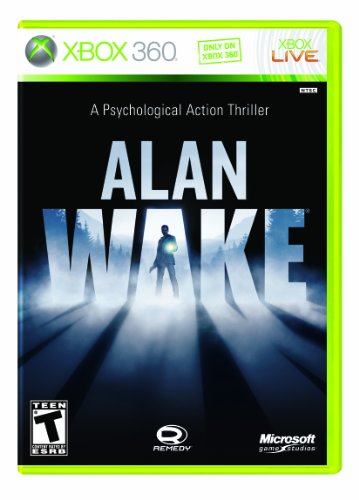
Alan Wake

Stephen King once wrote that nightmares exist outside of logic, and there’s little fun to be had in explanations. They’re antithetical to the poetry of fear. In a horror story, the victim keeps asking, ‘Why?’ But there can be no explanation, and there shouldn’t be one. The unanswered mystery is what stays with us the longest, and it’s what we’ll remember in the end.”

That’s the voiceover that begins Alan Wake, a game that borrows more than a little from King’s oeuvre. The game was written by Sam Lake, who also wrote the stories for the Max Payne series, but I fear he’s taken the wrong message from King’s words, and purposefully set out to write a story that makes no sense. That’s not quite the same thing.

I have few words for Alan Wake’s gameplay, which is neither awful nor fantastic. I echo the praise for the game’s atmosphere and its associated light/dark gameplay mechanic. But I could write a whole book (under the guidance of my own particular Dark Presence, no doubt) about this game’s incoherent plot.

Early on, I had my own theories about what was actually going on, about which parts were real and which were not. About halfway through, the story shifted in a way that invalidated most of my theories. It seemed to be building toward an ending that I wouldn’t have liked, but would have respected, because it would at least have given measurable meaning to the events of the game.

Soon after, though, the story veered off and headed straight to Crazytown. There were exits along the way — opportunities for the plot to get back on the Sense-Making highway — but by then the cruise control had been engaged and nobody was behind the wheel. (I’ve abused this metaphor.)

The game has an ending — or, at least, a series of disjointed vignettes; I only know it was the ending because it happened right before the credits. “But surely they’re setting up a sequel,” you might be saying, and you’d be right; but that’s part of the problem.

There is economic incentive for Remedy to make Alan Wake into a franchise. You make more money from three games (and the odd bit of DLC) than from one. But sequels must build upon solid foundations. You don’t make one story into two by chopping it in twain, just like you can’t separate a verse and a chorus and call them two different songs.

Which brings me back to King’s remark. If you’ll humor me, there’s a vast difference between a story that cannot be explained and one that makes no sense.

Thrillers often feature supernatural elements that prey upon the fears of the charaters and the audience alike, and that’s fine. I don’t need to know why there’s a sinister clown called Pennywise who torments a ragtag group of kids in a small town in Maine. I’m happy to accept it as the premise of a story that furthers some other storytelling goal.

Similarly, I’m more than willing to accept the unexplained “Dark Presence” that pushes the titular author to finish a manuscript that becomes reality as he’s typing it. But I can’t forgive a story that deliberately leaves plot threads unresolved, which appears to arrive at “answers” that are mutually incompatible, which leaves the reader to “draw her own conclusions” when there are no conclusions to be had. It’s the crutch of an unskillful writer. Other stories, and even other video games, commit the same sin. As far as I know, none tries to justify it with a misreading of something another author said.

Alan Wake divides itself into episodes, each with its own cliffhanger; it begs to be judged by the way it creates mysteries and then solves them, as if it were Twin Peaks or Lost. I am happy to oblige: by this standard, the game is shit.

Jun21


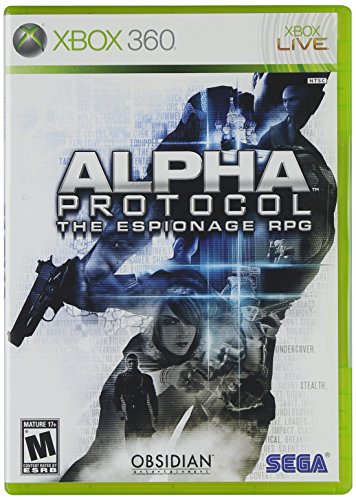
Alpha Protocol

The Zero Punctuation review of Alpha Protocol fails to convey just how awful the core gameplay is. It feels like they wanted to adapt the Unreal Engine in the same way that BioWare did for Mass Effect, but got only halfway there before they needed to ship.

Yahtzee does mention, however, one of my other frustrations: the game fails to convey the consequences of possible actions. Twenty minutes in, you find yourself standing in front of a computer terminal at the headquarters of the titular agency. The game offers you the option to hack the terminal. A guard is standing right next to it.

I hesitated because I didn’t know what the consequences would be. How does “hacking” work in this universe — is it discreet enough that the guard won’t know I’m doing it? Am I liable to get caught by someone else?

An aside: “moral choices” in video games are, to me, more about cost vs. benefit than right vs. wrong. Because my real-world morality may not map to the world depicted in the game, and because “being evil” is a legitimate and common play strategy, I need to know how the decisions I make serve game-related ends. Hacking a terminal is a good example: if I know it carries both a bonus and a penalty (e.g., you get access to information, but security is heightened after the intrusion is discovered), I can make an informed decision about whether to take the gambit.

As it turns out, hacking the terminal resulted in a small XP boost and access to some boring e-mails intended for other people. The guard didn’t notice a thing.

Ultimately, though, the crappy gameplay is the game’s undoing. If it were just a bit better, I’d be able to tolerate it long enough to get into the (widely-acclaimed) plot. Instead, it’s going into an envelope and back to Gamefly.

Feb28


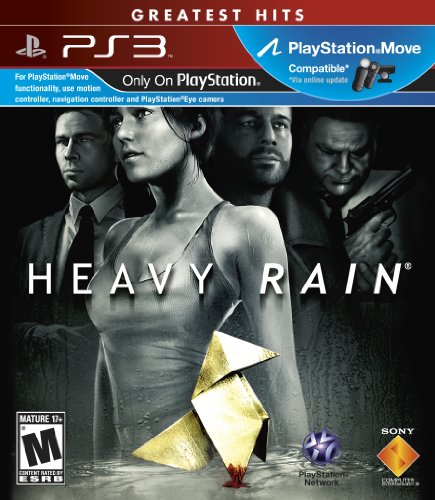
Heavy Rain

A couple years ago, I stumbled upon a game called Masq. It’s a simple game with the art style of a comic book — a bunch of still frames with no sound — but each choice you make affects the final outcome in significant ways. I played at least four times and never had the same ending twice.

I’d forgotten about Masq until I played Heavy Rain. They’re both interactive dramas (a sparsely-populated genre, to say the least), but the new PS3 offering aims to meld the forking plotlines of Masq with the atmosphere and immersion of high-tech games.

Developer Quantic Dream is aiming to break new ground in both story and storytelling. To distinguish between them, I need only recall Indigo Prophecy, the studio’s previous game: it used fascinating storytelling mechanisms to convey a story that was utter shit.

Well, they’ve fixed that part. I spent the entire game somewhat fearful that the plot would veer into WTF territory, but it didn’t. Instead, I got a simple-yet-compelling noir plot, plenty of meaningful choices, and a unique ending. No, I mean a unique ending; there are seven in total, the most I’ve seen in a game since Chrono Trigger.

The main story is about eight hours long, but I’ve already finished two playthroughs, and I know I’ll revisit Heavy Rain at least once a year to remind myself how a game should tell a story.

Feb14


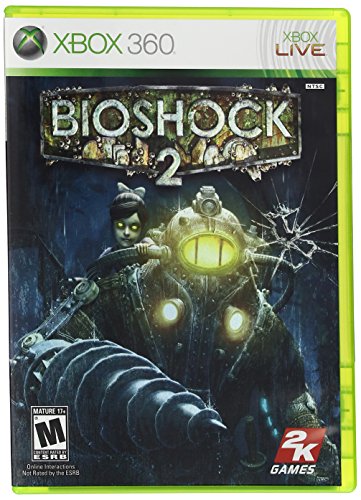
2">Bioshock 2

For most sequels (though Mass Effect 2 is a notable exception), my expectations are largely diminished — even when the original is one of my favorite games of all time.

That’s why I was satisfied with Bioshock 2, even though it’s not as good as the first. The gameplay improvements (dual-wielding weapons and plasmids!) are much appreciated. The setting and backstory are solid; it was nice to see how Rapture’s other half lived, and how the city’s class stratification laid the grounds for a collectivist counter-movement.

But the plot, when viewed up close, grew more and more incoherent as the game progressed. The last two hours are spent communicating with an ally over radio; I started to feel like her only purpose was to explain a plausible plot rationale for why you had to go to place X and do thing Y, over and over again.

The main villain is depicted as the ideological opposite of Bioshock’s Andrew Ryan. But Bioshock documented the events that turned an ambitious mogul into a hypocritical authoritarian. Sofia Lamb, on the other hand, has no depth to her villainy, and seems to undergo no character development in the two decades she’s spent under the ocean.

But, again, I nitpick because I love. I’m in the middle of my second playthrough and will be first in line for Bioshock 3.

Feb1


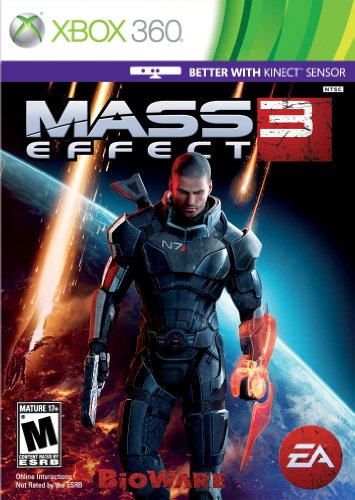
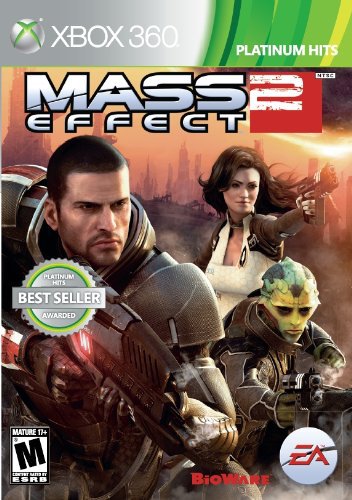
2">Mass Effect 2

On one hand, it boasts a story of comparable quality and a leap forward in combat gameplay. It easily warrants more than one playthrough.

On the other hand… must they excise so much of what makes a game an RPG? I’m speaking mostly about the level system, looting, item customization, and a handful of other things that were completely retooled from the previous Mass Effect.

But in one other aspect, too. In the real world, stuff exists on the edges of the frame. Stuff you’ll never end up examining in detail, but which exists even so. This stuff is important! It lends crucial verisimilitude to the game’s universe! When it’s trimmed, as it seems to have been in Mass Effect 2, that universe feels stark and linear, as though you were on a “save the galaxy” amusement park ride. Tycho explains it better.

Jan2


2: Among Thieves">Uncharted 2: Among Thieves

You don’t need me to tell you how good this game is; the rest of the gaming world got there first. I don’t know if any one game can be a “system-seller” — but if you already own a PS3, it’s inexcusable not to own Uncharted 2.

It’s not just good; it’s unusually, surprisingly good. It’s unusual for a game to be this much better than its prequel. It’s unusual for a game to make such large graphical leaps over its prequel on same-generation hardware.

But most of all, it’s unusual for a game to have this much polish. Video games are developed according to rigorous schedules, lest the technology become outdated before the game’s done. Nearly all games, regardless of quality, have to scale back their ambitions in order to ship on time.

Maybe there’s stuff that didn’t make it into Uncharted 2. But it doesn’t look that way from the outside. If Naughty Dog have figured out how to streamline the game development process, then they possess a competitive edge far more important than tech specs.

Dec21


3">Fallout 3

Let’s get straight to the point: Fallout 3, despite its minor flaws, is the closest I’ve felt to inhabiting a real-life world inside a video game. It’s built for exploration and will deliver enough substance for at least a hundred hours of gameplay. On top of all this, enemies’ heads explode if you shoot them just right — and that’s pretty cool by itself.

Aug31


BioShock

I’m late to the review party (I was too busy playing the game), so all the superlatives have been used up, but Bioshock is the undisputed Game of the Year. The central plot is shaky at times, but the atmosphere created by the rich backstory and gorgeous scenery is the best I’ve ever experienced in a video game.

Nov18


Saints Row

A surprisingly-good clone of the Grand Theft Auto games. The plot isn’t as good, though, and it suffers from some bizarre and frustrating bugs.

Nov10


II">Guitar Hero 2

The new features are fantastic (practice mode, cooperative multiplayer), and there are some excellent songs in this version, but the game doesn’t jell the way the first one did. I am glad I’ve got a new plastic guitar to replace my old one — the whammy bar had broken off and the strum bar was getting a little flimsy.

Painfully Obvious was built with WordPress, Prototype, Slicehost, and other accoutrements. Colophon →